The Hidden Cancer Risk Facing Thousands of New Zealanders: Why Viral Hepatitis Deserves the Same Urgency as Smoking
When you ask anyone to name a major cause of cancer, smoking is almost always the first response. We have decades of public health messaging, clear warnings on packaging, and widespread awareness connecting tobacco to lung cancer.
However, a groundbreaking study published in the Journal of Viral Hepatitis reveals a stark reality that too few people talk about: living with viral hepatitis carries an even greater cancer risk than a pack-a-day smoking habit.
Led by Carolyn Wallace and published via the Polaris Observatory, this comprehensive meta-analysis synthesised data from 126 studies involving over 86 million participants worldwide. The goal was simple yet urgent: compare the likelihood of developing liver cancer from viral hepatitis and metabolic conditions against the widely understood risk of developing lung cancer from smoking.
The findings demand our attention.
Understanding the Numbers: Relative Risk of Cancer
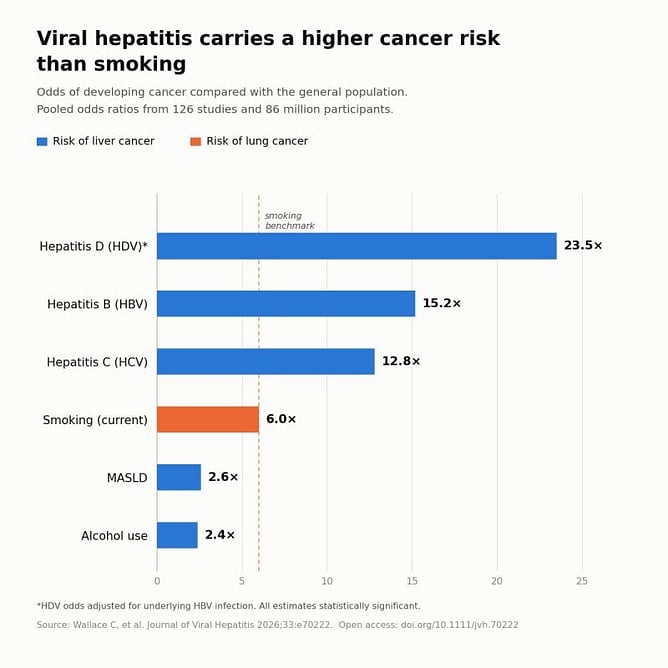
Compared to the general population, the odds of developing cancer increase dramatically when exposed to key risk factors:
Factor | Condition | Increased Odds of Cancer |
|---|---|---|
Smoking | Lung Cancer | 6.0× higher odds |
Hepatitis C (HCV) | Primary Liver Cancer | 12.8× higher odds |
Hepatitis B (HBV) | Primary Liver Cancer | 15.2× higher odds |
Hepatitis D (HDV Co-infection) | Primary Liver Cancer | 23.5× higher odds |
Put into perspective:
A person living with chronic hepatitis B or hepatitis C has 2 to 2.5 times the risk of developing liver cancer compared to a pack-a-day smoker’s risk of developing lung cancer.
For those co-infected with hepatitis D, that risk surges to nearly 4 times higher.
A Disease You Can Prevent and Treat
The crucial difference between viral hepatitis and many other cancer risks is that viral hepatitis-related cancer is largely preventable.
Liver cancer remains one of the fastest-growing causes of cancer death in Aotearoa New Zealand, often disproportionately affecting Māori, Pacific peoples, and migrant communities. Because hepatitis B and C can stay silent for decades without obvious symptoms, thousands of Kiwis may be living with an unmanaged viral infection without realising the long-term impact on their liver health.
What This Means for You and Your Whānau
Hepatitis B is controllable: While there is no cure yet for chronic hepatitis B, safe and effective treatment is readily available in New Zealand. Regular monitoring keeps the virus under control and drastically lowers the risk of liver damage and cancer. A highly effective vaccine is also part of the routine childhood immunisation schedule.
Hepatitis C is curable: Highly effective, oral direct-acting antiviral (DAA) medications can cure over 95% of hepatitis C cases in just 8 to 12 weeks with minimal side effects. Treatments are funded by PHARMAC and accessible through your GP or primary care health service.
Screening saves lives: A simple blood test or finger-prick test is all it takes to know your status. Early detection is the single most effective way to prevent severe liver complications.
Taking Action Today
We talk openly about quitting smoking to protect our lungs. It is time we bring the same level of awareness and proactive action to protecting our livers.
If you have never been tested for hepatitis B or C, or if you were diagnosed with hepatitis B in the past and haven't had a check-up recently, taking the next step is straightforward.
How We Can Help
The Hepatitis Foundation of New Zealand provides free support, monitoring, and educational resources across Aotearoa.
Check your status or register for monitoring: Call our helpline free on 0800 33 20 10 or visit our website to get tested or enrolled in regular liver health monitoring.
Read the full open-access study: You can read the complete paper published in the Journal of Viral Hepatitis here.
The study was funded by the John C. Martin Foundation through the Polaris Observatory and co-authored by researchers from leading global liver research organisations.